
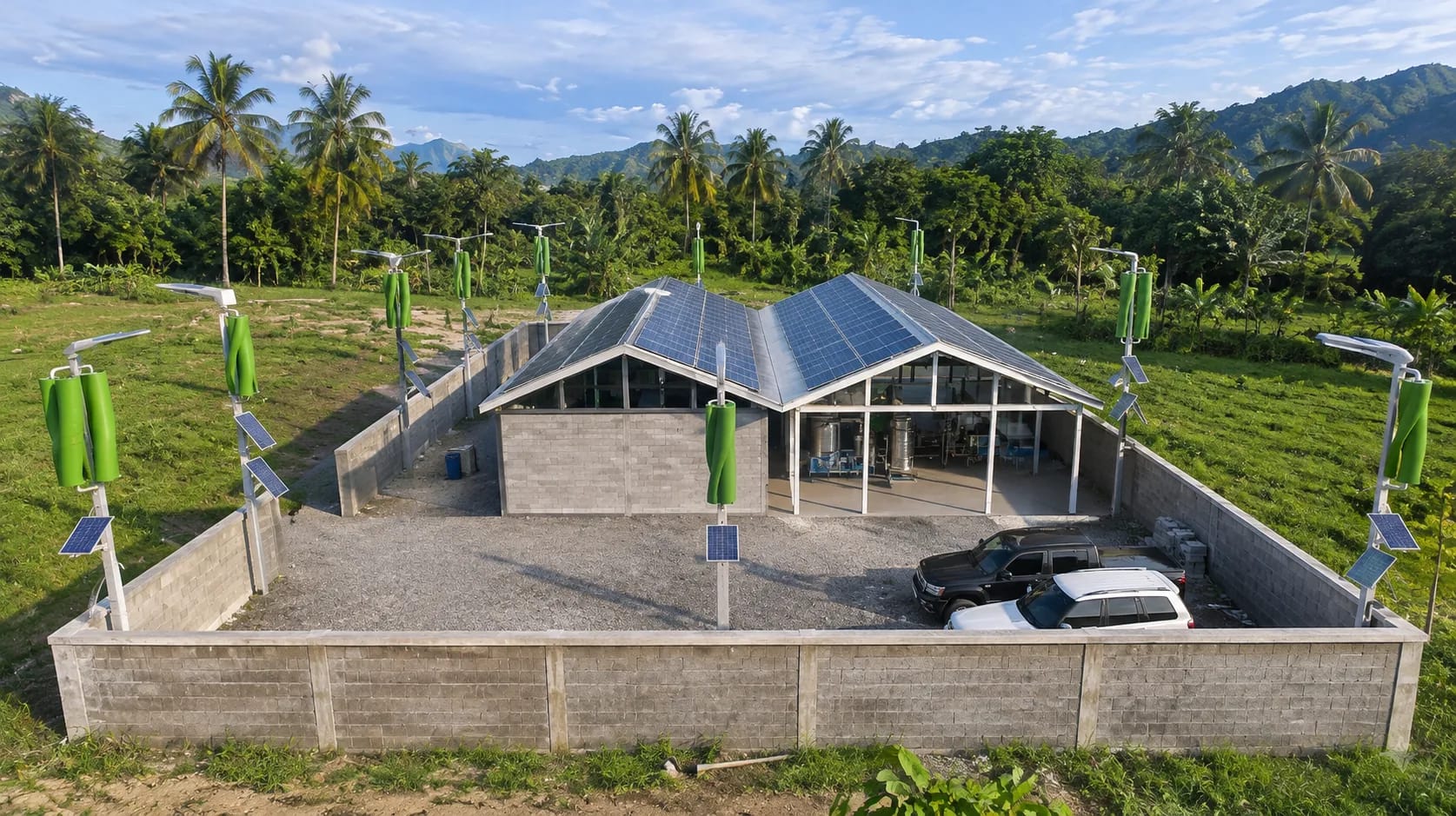
ESMI 10-tonner
The ESMI 10-tonner: from mine-waste heap to clean land, on one site.
A complete plant in one walled yard: crushing, grinding, separating and brick pressing, with ESMI microbes circulating through every part to capture the mercury. Powered by wind, sun and the grid.
10 t/h
throughput
ESMI programme model, Nov 2026
49,640 t/yr
two shifts, 7 days, 85% availability
ESMI programme model, Nov 2026
26
permanent jobs: two shifts of eight, reserves, cooks and an administrator; at least 80% from nearby villages
§ 3.2
about 316,000 m²
paving per unit per year
ESMI programme model, Nov 2026
Why this plant
Today’s methods deal with one part of the problem. The 10-tonner deals with all of it.
Each method in use today solves one part: it recovers gold, covers the waste or binds it in concrete. The ESMI 10-tonner adds no mercury or cyanide, captures the old mercury with microbes, recovers gold, silver, platinum, palladium and titanium, and presses everything that is left into bricks. Nothing goes back on the heap.
| Method | Mercury amalgamation (tromol) | Cyanide leaching | Gravity only | Capping or landfill | Cement stabilisation | ESMI 10-tonner |
|---|---|---|---|---|---|---|
| No mercury or cyanide added | No | No | Yes | Yes | Yes | Yes |
| Removes the mercury already in old waste | No | No | Partly | No | Partly | Yes |
| Recovers gold and other metals | Yes | Yes | Yes | No | No | Yes |
| Leaves no new heap: the rest becomes a product | No | No | No | No | Partly | Yes |
| Land returns to the village for new use | No | No | No | Partly | Partly | Yes |
Comparison: ESMI review of published methods for gold-mine waste.
Inside the plant
From mine waste to bricks, station by station.
Follow the waste through the 10-tonner: in through the gate as mine waste, out as clean bricks.
Closed loop
ESMI microbes run through every station.
ESMI microbes are pumped round a closed loop through every part of the plant: mills, spiral, shaking tables and water bath. On the way they turn the mercury, harmful as a liquid, into a solid that can be removed, and break down the cyanide. The sand that leaves the loop is clean.
- Mills
- Spiral
- Shaking tables
- Water bath
- Back to the mills
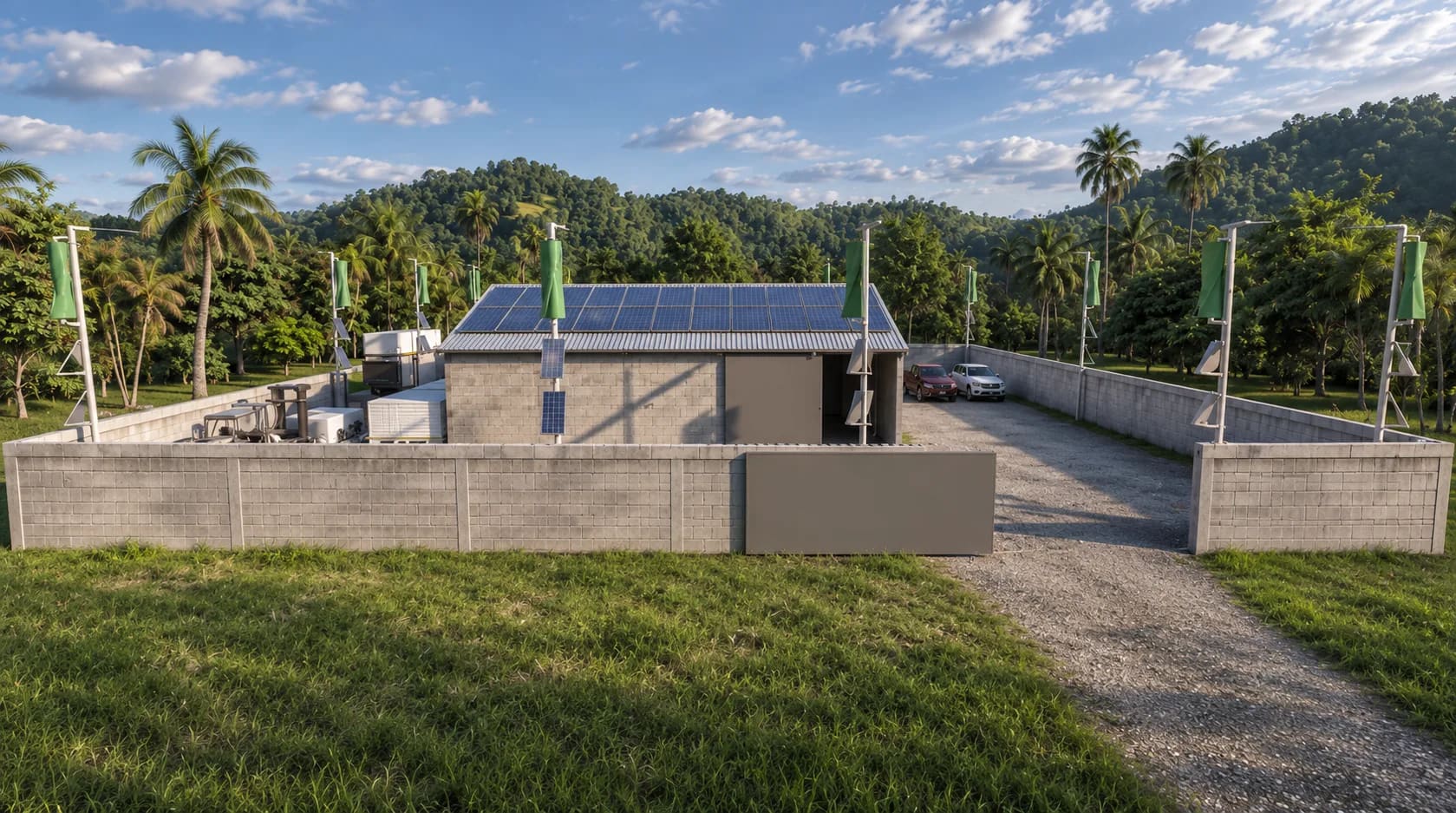
Station 01
One walled yard
The whole plant stands inside one walled yard. Mine waste comes in through the gate; clean bricks leave. Nothing is processed in the open.
In: mine waste from the heap
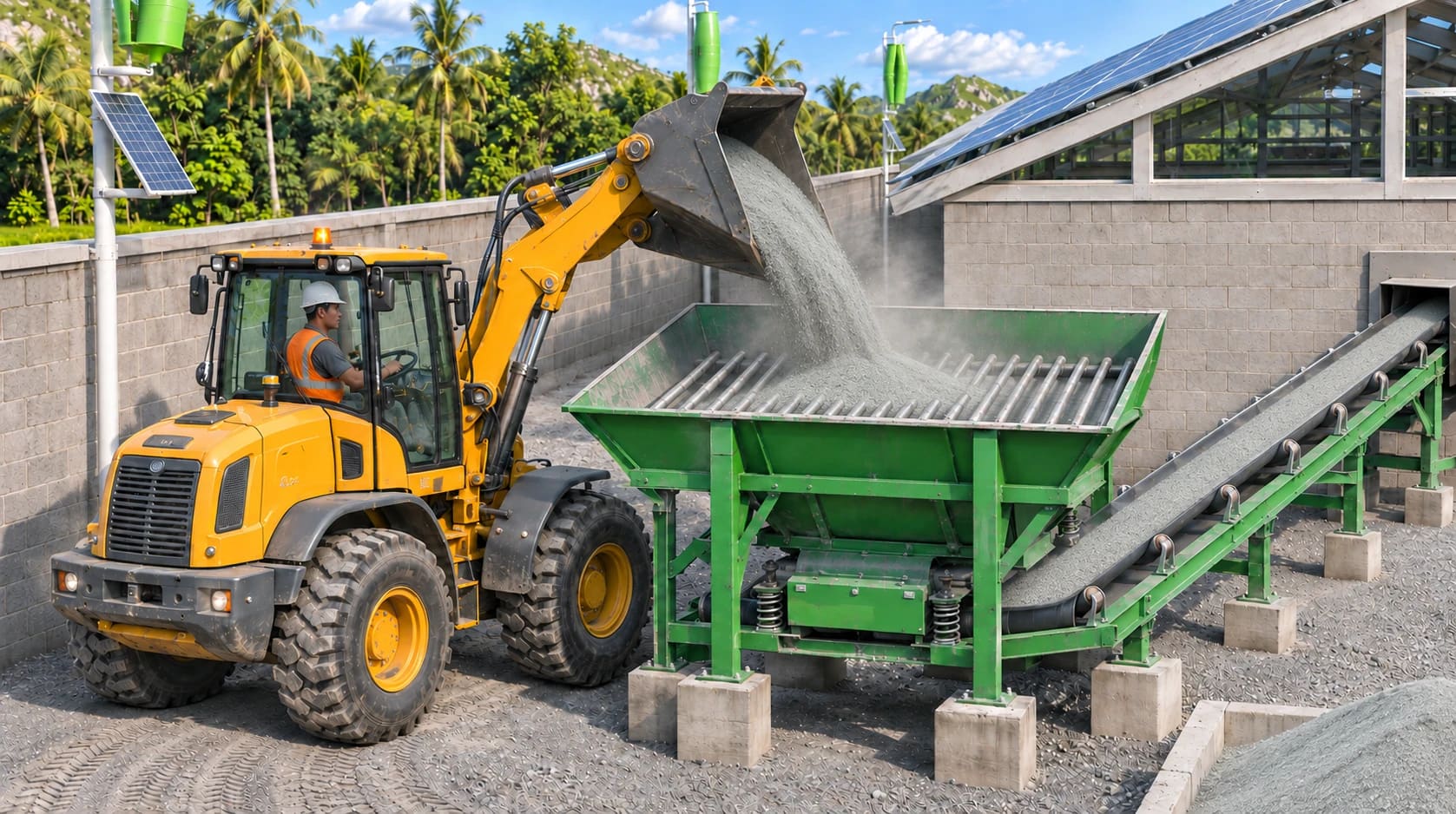
Station 02
Into the hopper
A wheel loader tips the mine waste into the feed hopper. A steel grid holds back the large stones; a conveyor carries the rest into the hall, to the jaw crusher.
Out: waste on the conveyor to the jaw crusher
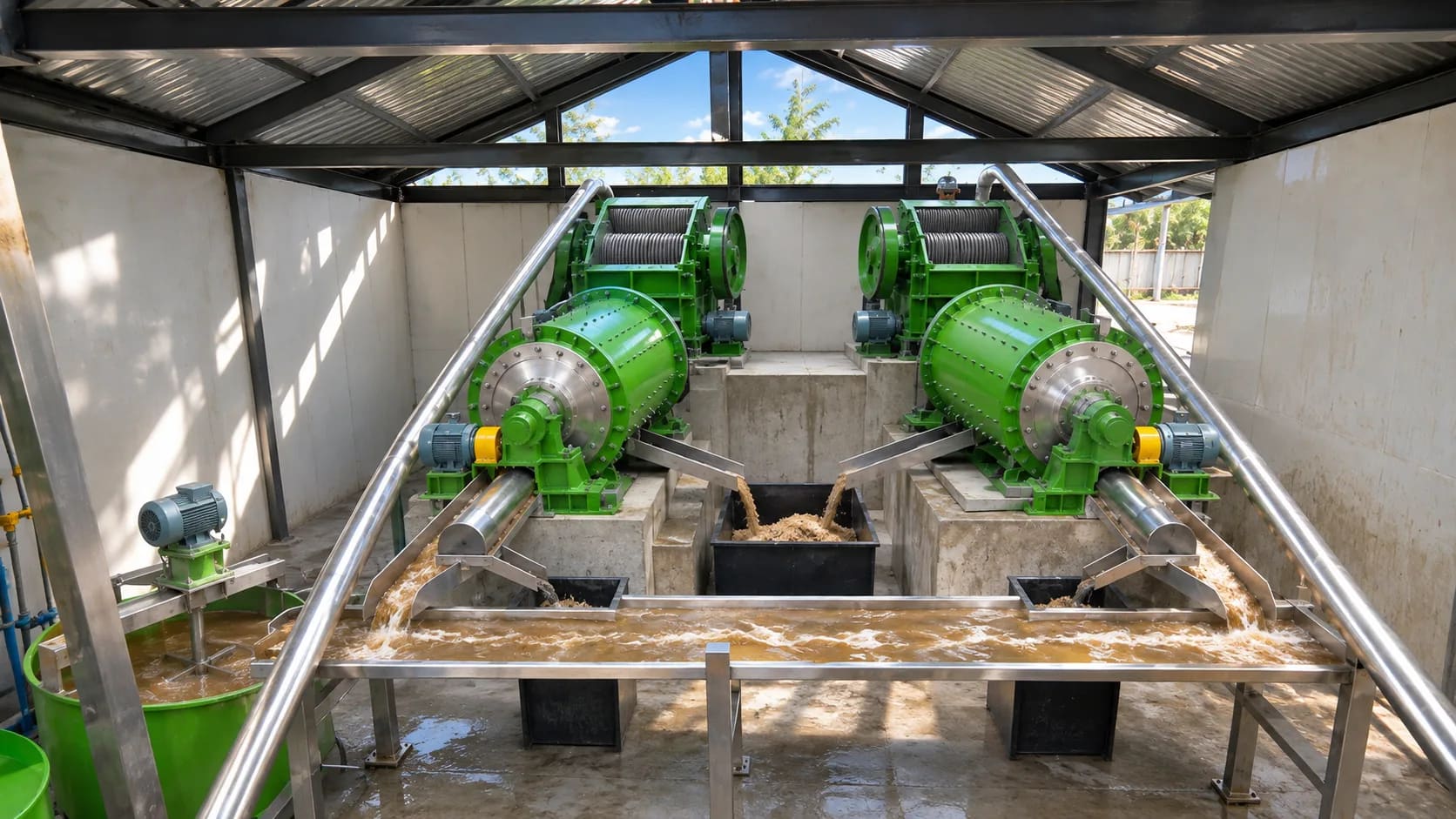
Station 03
Crush and grind
A jaw crusher and a second crusher break the waste down; two ball mills grind it fine. The finer the sand, the better the microbes reach the mercury bound to it.
Out: fine slurry
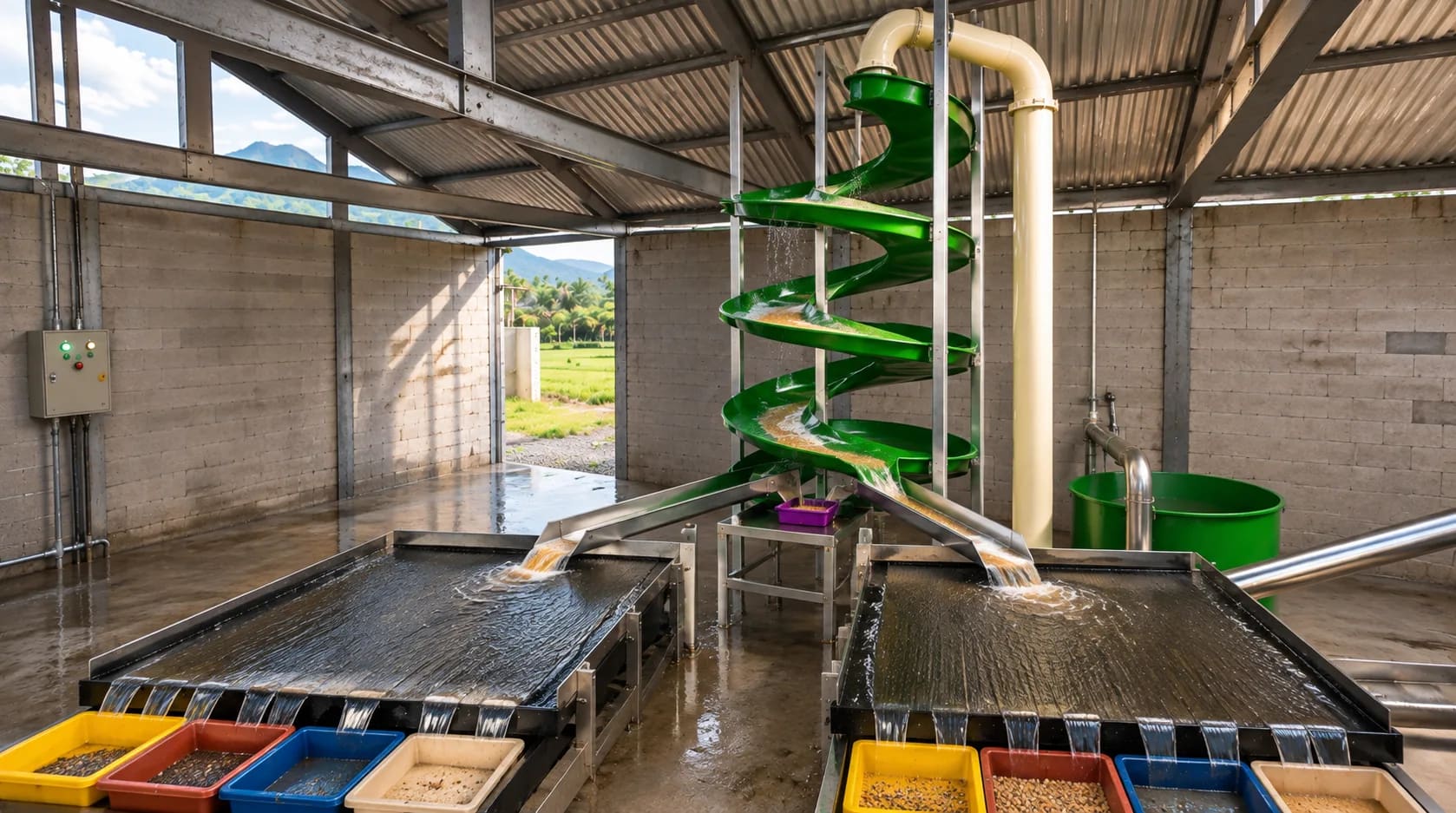
Station 04
Separate on the spiral
The slurry runs down the green spiral. Heavy grains, gold among them, sink to the inside of the curve and are split off from the light sand.
Out: heavy concentrate and light sand
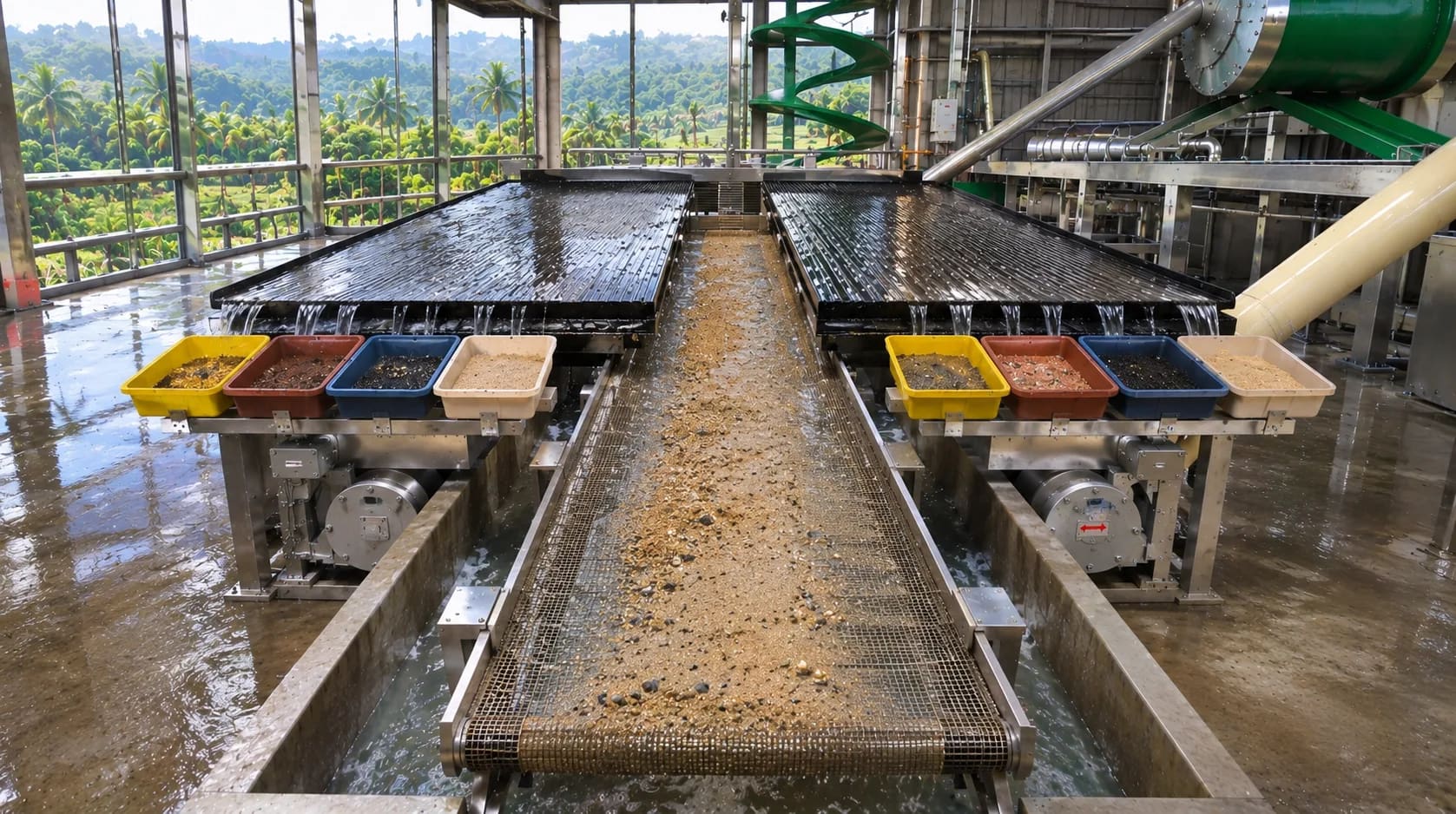
Station 05
Sort on the shaking tables
Two shaking tables sort the concentrate by weight into separate trays: gold, silver, platinum, palladium and titanium. The rest runs over a mesh belt above the water bath, and the water returns to the loop.
Out: gold, silver, platinum, palladium and titanium, sorted
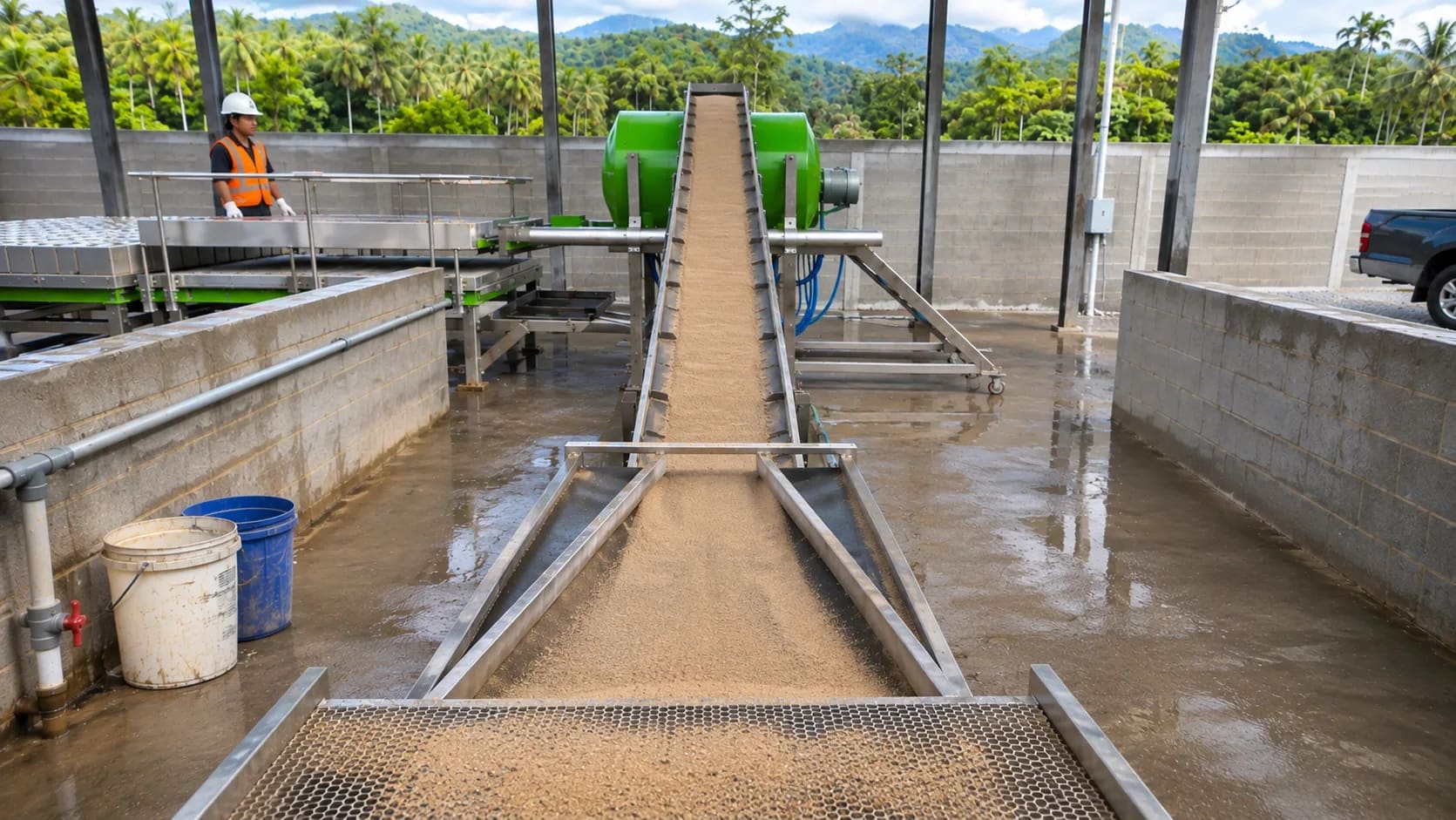
Station 06
Clean sand to the mixer
The cleaned sand rides the conveyor up into the green mixing drum, where cement is added. All of the sand goes in. It is the raw material for the bricks.
Out: brick mix
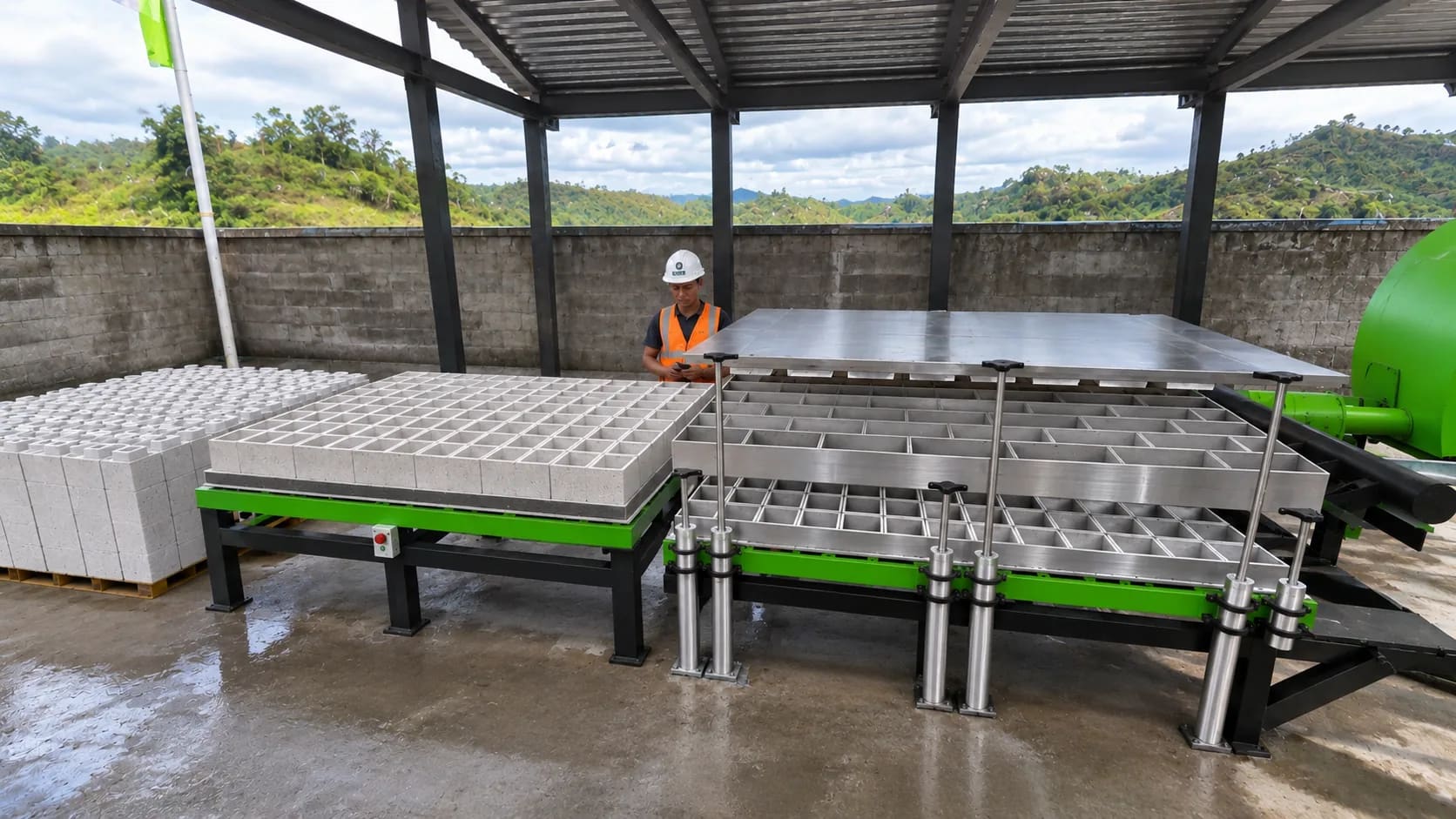
Station 07
Press the bricks
A hydraulic press fills the moulds and presses a full board of blocks at a time. A shaking conveyor carries them out.
Out: fresh blocks, 20 × 10 × 10 cm
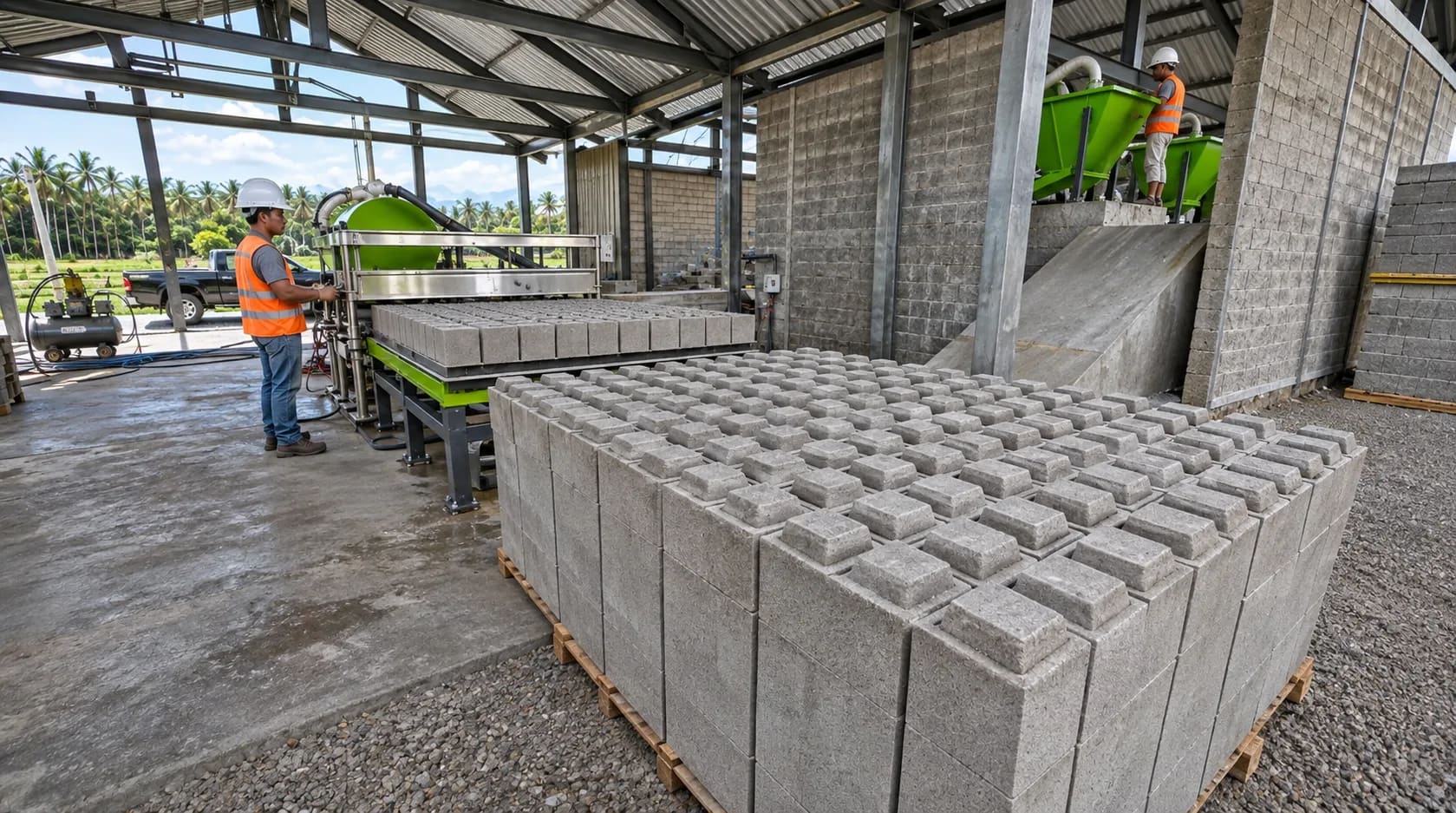
Station 08
Dry and ship
The blocks air-dry on pallets and leave the yard by truck, for roads, houses and walls in the surrounding villages.
Out: about 316,000 m² of paving a year
Station 09
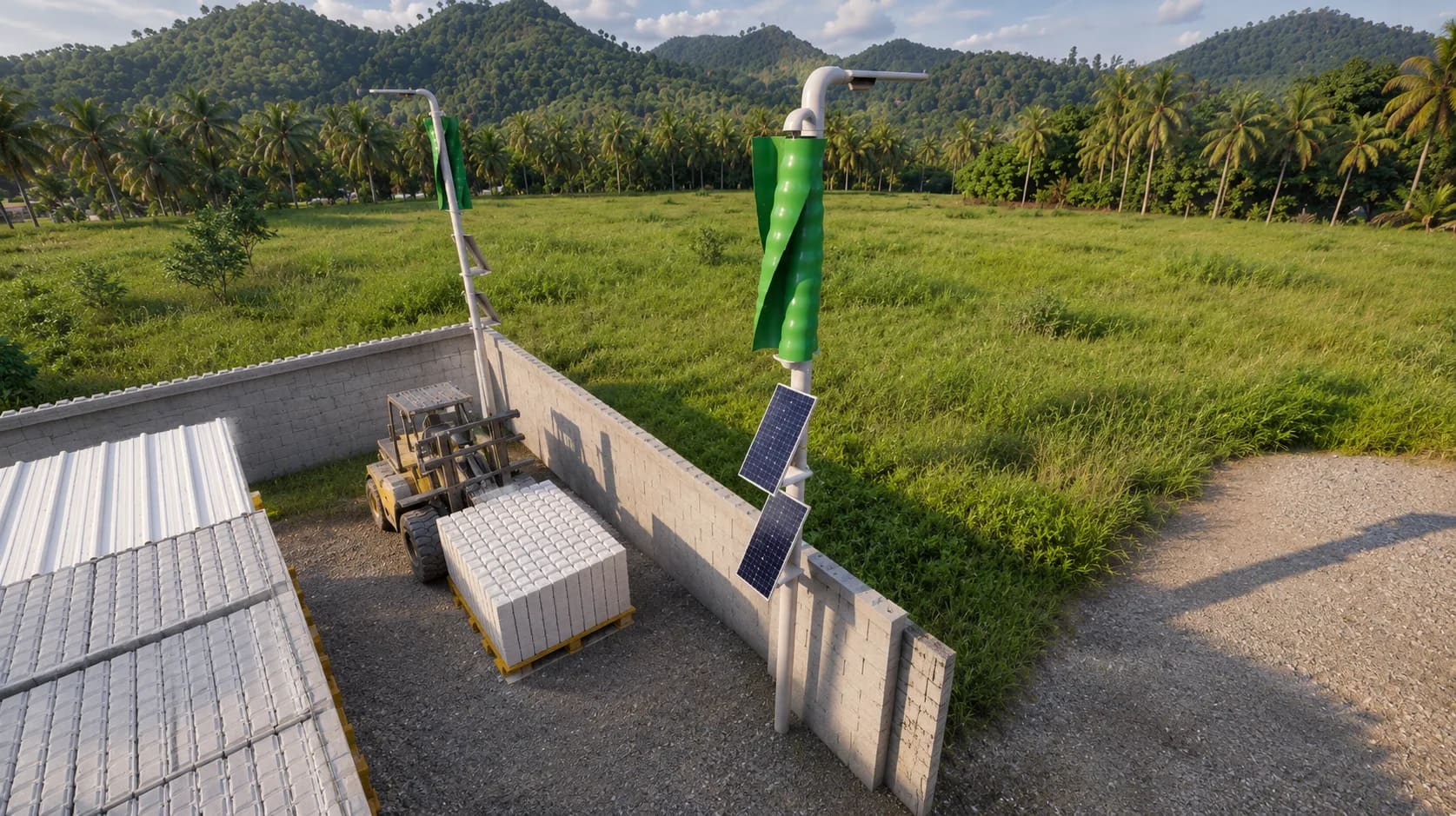
Power from wind, sun and the grid
Solar panels sit on the roofs. Each pole carries a vertical wind turbine, two solar panels, an LED light and a 360° camera. With a grid connection they power the plant, and the site is watched day and night.
Power and security on site
The evidence
Six reasons, each on the record.
Every figure below comes from a peer-reviewed study, a UN report or Indonesian law.
37.7 %of global man-made mercury emissions to air come from small-scale gold mining
Small-scale gold mining is the largest mercury source in the world.
Small-scale gold mining emits more mercury to air than any other human activity. A plant that adds no mercury and removes the mercury already in the waste goes straight at that source.
Source: UN Environment Programme (2019), UN Environment Programme, Chemicals and Health Branch, Geneva
55 %of amalgam smelters (workers who burn gold bound with mercury) in North Sulawesi diagnosed with chronic mercury intoxication
The poisoning is measured in people, here and now.
The harm has been measured in people in North Sulawesi, where the first 10-tonner starts. Every heap cleaned removes a source of poison next to a village.
Source: Bose-O’Reilly S et al. (2010), Science of the Total Environment
3.5 kmdistance over which mine tailings spread from the pipe outlet, up to nearby coral reefs
Left alone or covered, the waste keeps spreading.
Mine waste spreads over kilometres and its mercury enters the food chain. Capping postpones the problem. The 10-tonner removes it.
Source: Edinger E (2012), Oceanography
40–120 mgof mercury bound per gram of dry bacterial biomass
Microbes make the mercury solid so it stops moving.
Bacteria bind mercury to their surface, so it no longer moves. That is the job of the ESMI microbes circulating through every station of the plant.
Source: François F et al. (2012), Applied and Environmental Microbiology
5–51 MPacompressive strength of tailings bricks across 15 studies
Waste sand makes bricks of building strength.
Fifteen studies show bricks from mine tailings reach building strength, with heavy metals locked in. The waste does not go back on a heap. It becomes roads, houses and walls.
100 %mercury to be eliminated from small-scale gold mining, with 2025 as the target year
The law already requires it. The deadline has passed.
Indonesia ratified the Minamata Convention and set 2025 as the target for mercury-free small-scale gold mining. That target was missed. The 10-tonner is a way to meet it.
Worldwide
Every gold-mining country has these heaps.
From the Amazon to West Africa and Southeast Asia, small-scale gold mining has left the same mercury and cyanide waste. A plant that cleans it and turns all of it into bricks can work wherever that waste lies.
Price
USD 1.7 mln
one complete 10-tonner, feed to brick, with sensors
EstimateESMI programme model, Nov 2026
USD 36.80 /t
full cost per tonne: processing, lease, lab, mercury, restoration, site and camp, training, hub
EstimateESMI programme model, Nov 2026
USD 39.20 /t
average clean-up fee per tonne over ten years
EstimateESMI programme model, Nov 2026
Open-book cost-plus: the fee covers all costs, including staff, site set-up, camp, training at the ESMI academy and government relations, and is reviewed every year. From 2029 the machines are built in two ESMI factories in Indonesia.
Specifications
One complete unit, from feed to brick.
- Throughput
- 10 tonnes per hour
- Operation
- Two shifts, 16 hours a day, 7 days a week; 85% availability
- Processed per year
- 49,640 t
- Process
- Crusher, ball mill, two shaking tables, clear-water bath, brick press
- Water
- Closed circuit; POCO and about 0.2 L ESMI microbes per tonne dosed into the process water
- Outputs
- Mercury made solid and removed (sealed, safe storage), metal concentrate, tested sand for bricks
- Bricks per year
- Up to about 316,000 m² of paving
- Jobs
- 26 permanent jobs; at least 80% from nearby villages
- Sensors
- Tonnes, water quality (pH, ORP), mercury vapour, power; linked to the ESMI app
- Price
- USD 1.7 million per complete unit
- Full cost
- USD 36.80 per tonne, all-in
What a site needs
- Access
- A road for trucks and a loader to the heaps
- Power
- PLN grid plus wind and sun on site
- Water
- Make-up water for the closed circuit
- Site set-up
- Platform, roof, camp, security: about USD 290,000 per site
- Permits and consent
- Site designation, permits and the village’s prior consent
Business plan annex A; energy and throughput are confirmed in the pilot.
Who it is for
Governments and regencies
Designate sites and receive clean land, local jobs and bricks for roads and schools.
State companies and permit holders
Clean up their own concessions, including illegal mining on them.
Funders and funds
Pay per verified tonne, with open books and independent verification.
Every tonne visible
Sensors on each machine feed the ESMI app: tonnes, water quality, mercury vapour and power. Funders and government see progress per site.
Source: Business plan, annex A and B; §§ 2.1, 3.2, 5.3. Estimates until the pilot measures.
Request a briefing on the 10-tonner
We share the technical annex and the cost model on request.