
The programme
From one machine to 800. Each phase starts when the previous one has met its targets.
The programme starts with a pilot in Bolmong, North Sulawesi. Two Indonesian factories build the machines. Each regional hub supports ten units with a lab, a workshop, microbes and brick sales.
From one machine to 800, phase by phase.
- 2026Pilot in Bolmong under way; ESMI academy in Manado
- 2027First 10-tonner; national field verification with Unisma
- 2028–2029Two Indonesian factories build the machines
- 2031Mercury heaps cleaned up
- 2036All mercury- and cyanide-bearing waste processed; 800 units, 80 hubs, 20,800 jobs
What every site gets
ESMI academy
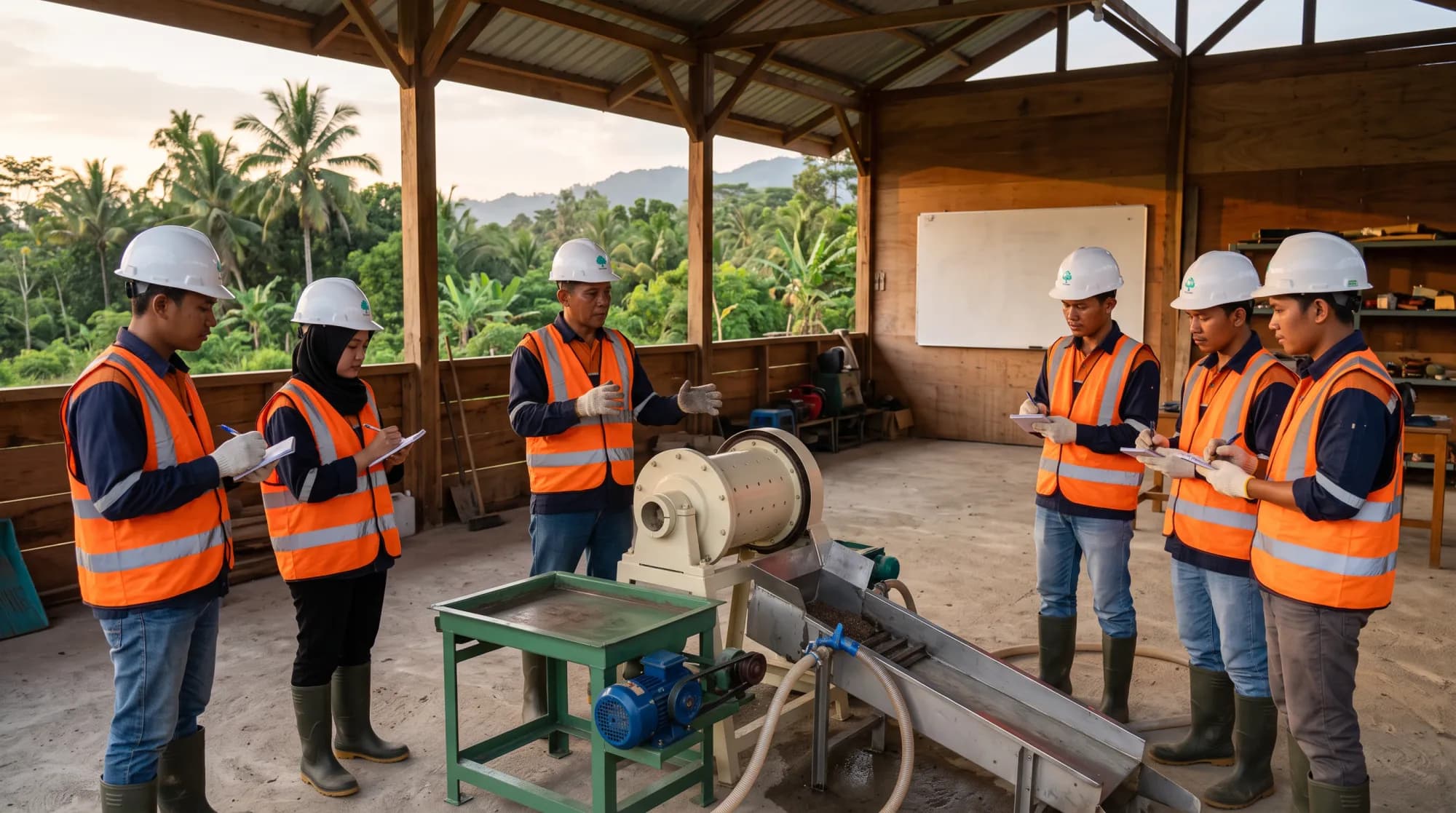
Every new employee trains for three months on a working 0.5 t/h machine, with safety and mercury first, then a yearly refresher. The training centre in Manado already has a machine; three regional centres follow.
Site and camp
Each site is prepared before work starts: access road, water, power, housing and security. A camp with meals and site administration keeps crews close to the work.
Government relations and outreach
A dedicated team works with provinces and regencies on permits and oversight, and informs villages in their own language before, during and after the work.
Three phases
| Phase | Years | Units | Need (USD mln, current prices) | Goal |
|---|---|---|---|---|
| 1 · Prove | 2027–2028 | 1–3 | 40.7 | Technology, cost and safeguards proven; factory 1 built; national baseline |
| 2 · Mercury heaps | 2029–2031 | 53–423 | 1,722 | Mercury-bearing residue processed; first regional hubs |
| 3 · Everything clean | 2032–2036 | up to 800 | 10,372 | All mercury- and cyanide-bearing waste processed, land restored |
Go/no-go between phases: throughput, cost per tonne, mercury balance, brick tests, village consent and an independently confirmed baseline.
Source: Business plan §§ 3.2, 4.1.
Targets per unit and per hub
| Indicator | Target |
|---|---|
| Processed per unit per year | ≥ 49,640 t (85% availability) |
| Cost per tonne | ≤ USD 36.80 |
| Brick batches below the Indonesian leaching limit (TCLP-B) and ≥ 10 MPa | 100% |
| Mercury mass balance; WAD cyanide | ±15%; < 0.5 mg/L |
| Hectares restored, checked by satellite | per site plan |
| Serious accidents | 0 |
| Local jobs; complaints resolved in 30 days | ≥ 80%; ≥ 90% |
Unisma: partner in delivery and science
National field programme
Field verification of the scan, impact research and the social baseline; then every new site.
Students on site
Four students per unit per year work in the crews, the lab and management; about 16,000 students trained by 2036.
Labs
Site labs and the accredited Unisma lab grow with the programme; one in ten samples is checked by Unisma.
Microbe culture
Unisma cultures the ESMI microbes for the whole country under ESMI licence.
Production and deadlines
The deadlines are set. Machine production is planned to meet them.
Two of ESMI’s own factories build up to 240 machines a year. The fleet grows from one unit in 2027 to 800 in 2033. The plan clears the mercury heaps by 2031 and treats all mercury- and cyanide-bearing waste by 2036, well before Indonesia Emas 2045.
800units in operation, 2033
80regional hubs at the peak
2031All mercury heaps gone
2036All mercury- and cyanide-bearing waste treated; land restored
units in operationof which new machines (incl. replacement after 5 years)
Mercury heaps gone (16.6 Mt)All mercury- and cyanide-bearing waste treated (180 Mt)Contaminated land restored (93,500 ha)
Show the numbers as a table
| Year | Units | New machines | Hubs | Mercury heaps | All heaps | Land |
|---|---|---|---|---|---|---|
| 2027 | 1 | 1 | 1 | 0 % | 0 % | 0 % |
| 2028 | 3 | 2 | 1 | 1 % | 0 % | 0 % |
| 2029 | 53 | 50 | 6 | 11 % | 1 % | 1 % |
| 2030 | 203 | 150 | 21 | 54 % | 5 % | 6 % |
| 2031 | 423 | 220 | 43 | 100 % | 14 % | 17 % |
| 2032 | 662 | 240 | 67 | 100 % | 30 % | 33 % |
| 2033 | 800 | 140 | 80 | 100 % | 50 % | 53 % |
| 2034 | 800 | 50 | 80 | 100 % | 72 % | 73 % |
| 2035 | 800 | 150 | 80 | 100 % | 92 % | 93 % |
| 2036 | 292 | 0 | 30 | 100 % | 100 % | 100 % |
How many factories are needed?
A factory delivers 50 machines in its first year, 100 in the second and 120 a year after that. Without an own factory the fleet stays near 192 machines and the clean-up runs past 2050.
Milestones
- 2026–27Bolmong pilot; first 10-tonner; Unisma field work
- 2028First own factory; second in 2029
- 2030Mercury-bearing tromol residue treated
- 2031All mercury heaps gone
- 2036All mercury- and cyanide-bearing waste treated; land restored
Agreed deadlines the programme works to
- 2025RAN-PPM target for mercury-free small-scale gold mining: missed
- 2029Central Java regional action plan: 100% mercury-free
- 2030RAN-PPM ends: “Indonesia bebas merkuri”
- 2030SDGs 3.9, 6.3, 12.4, 14.1, 15.3; Kunming-Montreal targets 2 and 7
- 2045Indonesia Emas (RPJPN 2025–2045)
Model estimate, to be measured Source: Business plan §§ 3.5, 3.6; calculation model sheet Programme 10 years (roll-out is input) and Landelijk; Perpres 21/2019; Pergub Jawa Tengah 10/2026; Agenda 2030; Kunming-Montreal GBF; RPJPN 2025–2045. There is no national end date for clearing mine waste; the programme dates are a proposal.
Human capital
Expertise counts as co-financing.
The programme needs people as well as money. Experts seconded by development banks, UN organisations, governments and universities count as in-kind co-financing at GEF and the World Bank.
Expertise the programme asks for
- Mine closure
- Geotechnics
- Water management
- Toxicology
- Monitoring
- Finance
16,148students trained in ten years, four per unit per year, in engineering, lab and management
20,800permanent jobs at the peak, 26 per unit, at least 80% from the villages around the site
Every new employee trains for three months on a 0.5 t/h machine at the ESMI academy in Manado, later in three regional centres. The best interns become site and hub leaders.
Show the numbers as a table
| Year | Students |
|---|---|
| 2027 | 4 |
| 2028 | 12 |
| 2029 | 212 |
| 2030 | 812 |
| 2031 | 1,692 |
| 2032 | 2,648 |
| 2033 | 3,200 |
| 2034 | 3,200 |
| 2035 | 3,200 |
| 2036 | 1,168 |
Model estimate, to be measured Source: Business plan §§ 1.3, 3.1, 3.2; model sheet Unisma (interns per year). Value of an expert-year ±USD 150,000 is an assumption; the number of expert-years is a proposal.
Gotong royong
The pilot is under way. The next step is scale.
The pilot in Bolmong has started. ESMI is now raising large-scale funding to clean up Indonesia’s mine waste. Investors can start with one 10-tonner (USD 1.7 million).
ESMI also works as a hired partner. Mining companies and cooperatives can bring in ESMI to upgrade an existing plant with its microbes and methods, so it recovers more and can move away from mercury and cyanide.