
POCO
POCO cleans nothing by itself. It makes the microbes work faster.
POCO is a microbe stimulator: food and activator. ESMI microbes, and the useful microbes already in the soil, grow and multiply faster with it. More microbes means faster, more complete cleaning.
What POCO is, and what it is not
A stimulator
POCO is a liquid made from plant extracts and fruit oils. It feeds and activates microbes and contains no microbes of its own. It is delivered as a concentrate and diluted with water on site.
Not a cleaning agent
POCO does not break down or bind toxins. The microbes do that work.
On every cell
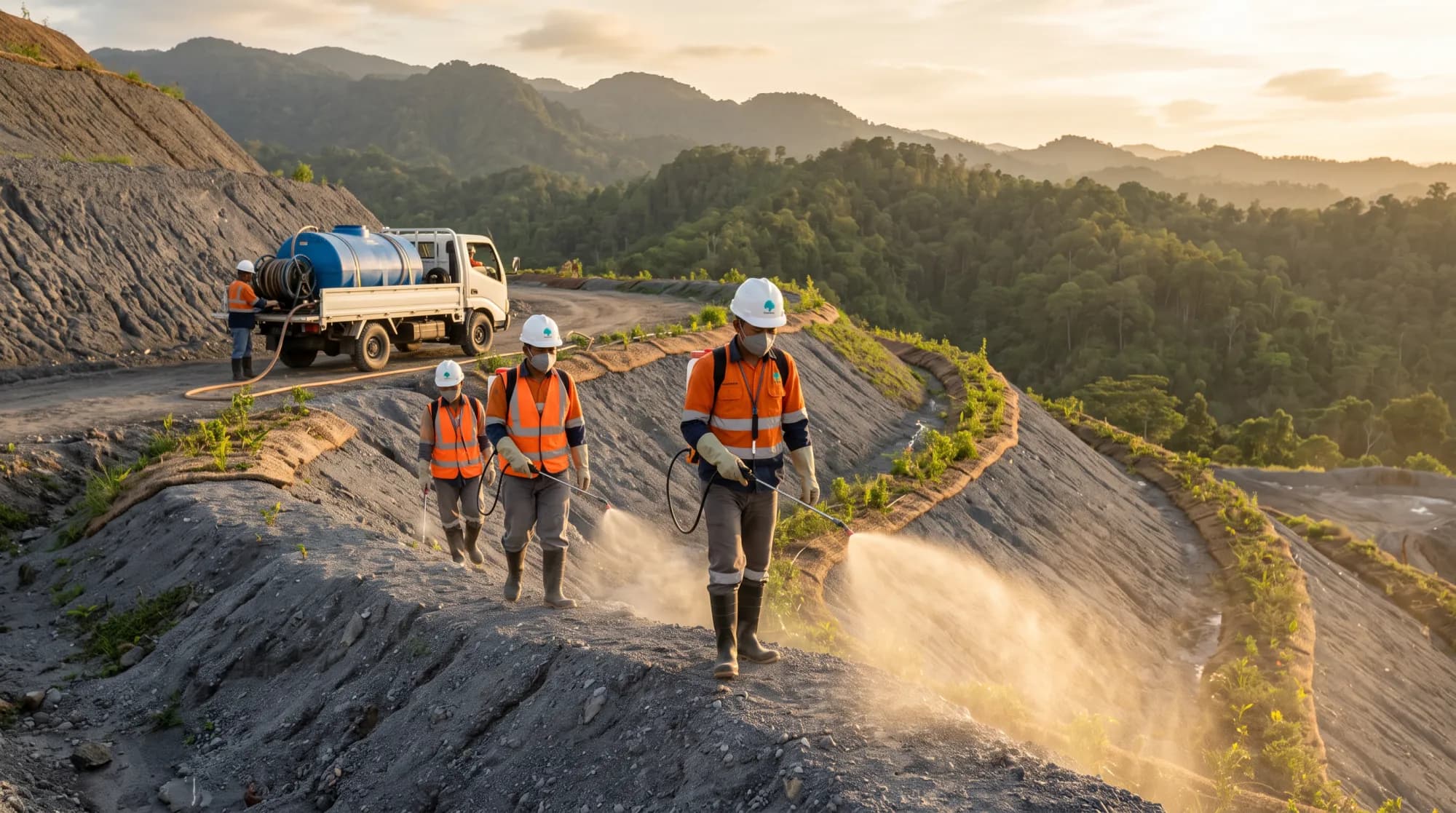
Every mined cell is treated with POCO and microbes before work starts, including where heaps are restored on site.
Used before
Before mine waste, POCO helped clean polluted water.
POCO was used on a lake full of sludge, on oil in lake water and on an urban lagoon fed by sewage. The results are encouraging. They come from pilots and monitoring, not from peer-reviewed trials, and they concern organic pollution. That is why ESMI tests POCO again, double-blind, on mine waste.
Paraguay · 2008
Lake Ypacaraí, San Bernardino
A closed-off pool in the lake, about 3,000 m³ with up to 40 cm of black sludge, was treated with POCO for nine weeks, from March to May 2008. Sampling ran under the supervision of the CEMIT research centre of the Universidad Nacional de Asunción.
Coliform bacteria fell from about 1,500 to about 200, blue-green algae declined and zooplankton increased. The water moved from a class where swimming is not allowed to a class safe for recreation. Tilapia put into the pool survived and bred.
One pool, without a separate control pool; storms broke the dam twice.
Venezuela · 2013
Lake Maracaibo, Zulia
A tank test with the national oil company PDVSA: tanks of 700 litres of lake water, with and without crude oil, treated with two doses of POCO and compared with an untreated tank.
Three days after treatment the organic load (BOD) was 9.8 mg/L in the untreated tank against 4.7 and 5.5 mg/L in the treated tanks (INZIT laboratory). Floating crude oil broke up and visibly fell by 40–50% within three days.
The fall in oil was judged by eye; coliform bacteria stayed high in all tanks.
Nicaragua · 2020
Laguna de Tiscapa, Managua
An urban crater lake that receives sewage. The city treated it with 114–300 litres of POCO a day together with an aerator. The CIRA water-research centre of UNAN-Managua monitored it from June to August 2020.
Oxygen was present down to the bottom at 39 m, where earlier studies found none below 4–5 m. The organic load (BOD and COD) was lower than in 2018.
The lagoon stayed over-fertilised, and the researchers could not separate the effect of POCO from the aerator and the rain.
In each case POCO worked on organic pollution: sludge, sewage and oil. Mercury and cyanide are a different task. There the ESMI microbes do the work, and POCO helps them multiply.
How it is applied
Two application points, one closed water circuit.
On the cell
The crew sprays POCO and ESMI microbes over the ground of each mined cell and mixes them in.
In the process water
POCO and about 0.2 litre ESMI microbes per tonne go into the process water of the 10-tonner. The water circulates and is reused.
On restored land
Where waste rock and sand are restored on site, POCO and microbes prepare the soil for planting.
How the effect is measured. The pilot tests POCO double-blind: treated cells against untreated cells, with microbe counts and measurements of mercury and cyanide. What has not been measured is not claimed.
Common questions
Does POCO remove mercury?
No. POCO helps the microbes multiply. The microbes make the mercury solid; the shaking table separates it; it goes to safe storage.
Is POCO safe for soil and water?
POCO is food for microbes. Water and soil are measured before, during and after the work, and the land is only reused when it meets the standard.
Where is POCO used besides mine waste?
In agriculture and aquaculture, as a soil and water stimulator. On this site we only discuss its role in mine-waste clean-up.
Source: Business plan § 2.1; masterplan Nov 2026. Effects are tested in the pilot (Bolmong, from December 2026).
Gotong royong
The pilot is under way. The next step is scale.
The pilot in Bolmong has started. ESMI is now raising large-scale funding to clean up Indonesia’s mine waste. Investors can start with one 10-tonner (USD 1.7 million).
ESMI also works as a hired partner. Mining companies and cooperatives can bring in ESMI to upgrade an existing plant with its microbes and methods, so it recovers more and can move away from mercury and cyanide.