
Sustainability policy
A clean-up company has to be clean itself. SBDI Foundation sets and checks how ESMI is run.
ESMI removes mercury and cyanide from gold-mine waste. The way it does that work also counts: how people are treated, what the machines run on, where the money goes and what happens to the land. SBDI Foundation, co-founder of ESMI, is responsible for that policy.
Who is responsible
SBDI Foundation, a UN Global Compact participant since 2021
SBDI stands for Sustainable Business Development & Innovation. The foundation co-founded ESMI in 2025 and sets and checks ESMI’s sustainability policy. The aim is a business that is as sustainable as it can be: for the people who live near the waste, for nature and for the long term.
SBDI has taken part in the UN Global Compact since 8 March 2021. It commits to the Ten Principles on human rights, labour, environment and anti-corruption, and reports on its progress. It has members and centres in Indonesia, Africa and the Middle East.
Participation in the UN Global Compact is a commitment by SBDI Foundation. It does not mean that the United Nations endorses ESMI or this programme.
- UN Global Compact
- Participant since 8 March 2021
- Role in ESMI
- Co-founder; responsible for the sustainability policy
- Led by
- Prof. Jeroen Rijnenberg, founder of SBDI and co-founder of ESMI
- Main fields
- Food security, entrepreneurship, education, land restoration
The principles
Four areas, applied to the clean-up
The UN Global Compact groups its Ten Principles in four areas. For each, this is what it means for ESMI’s work.
- 01
Human rights
No work starts without free, prior and informed consent in the village assembly. The land goes back to the village, and the village decides what it becomes once tests show the soil and water are safe.
- 02
Labour
Former miners get priority for legal, permanent jobs. Crews train before they start, wear protective equipment and have yearly medical checks. ESMI does not employ children.
- 03
Environment
Microbes make the mercury solid so it can be removed; cyanide is broken down. All of the residual sand becomes bricks. The plant runs on wind and sun plus a PLN grid connection, with water in a closed loop.
- 04
Integrity
Payments go digitally to the person. Results are measured, checked independently and published, including results that disappoint.
Food security
SBDI’s largest field: more food from local hands
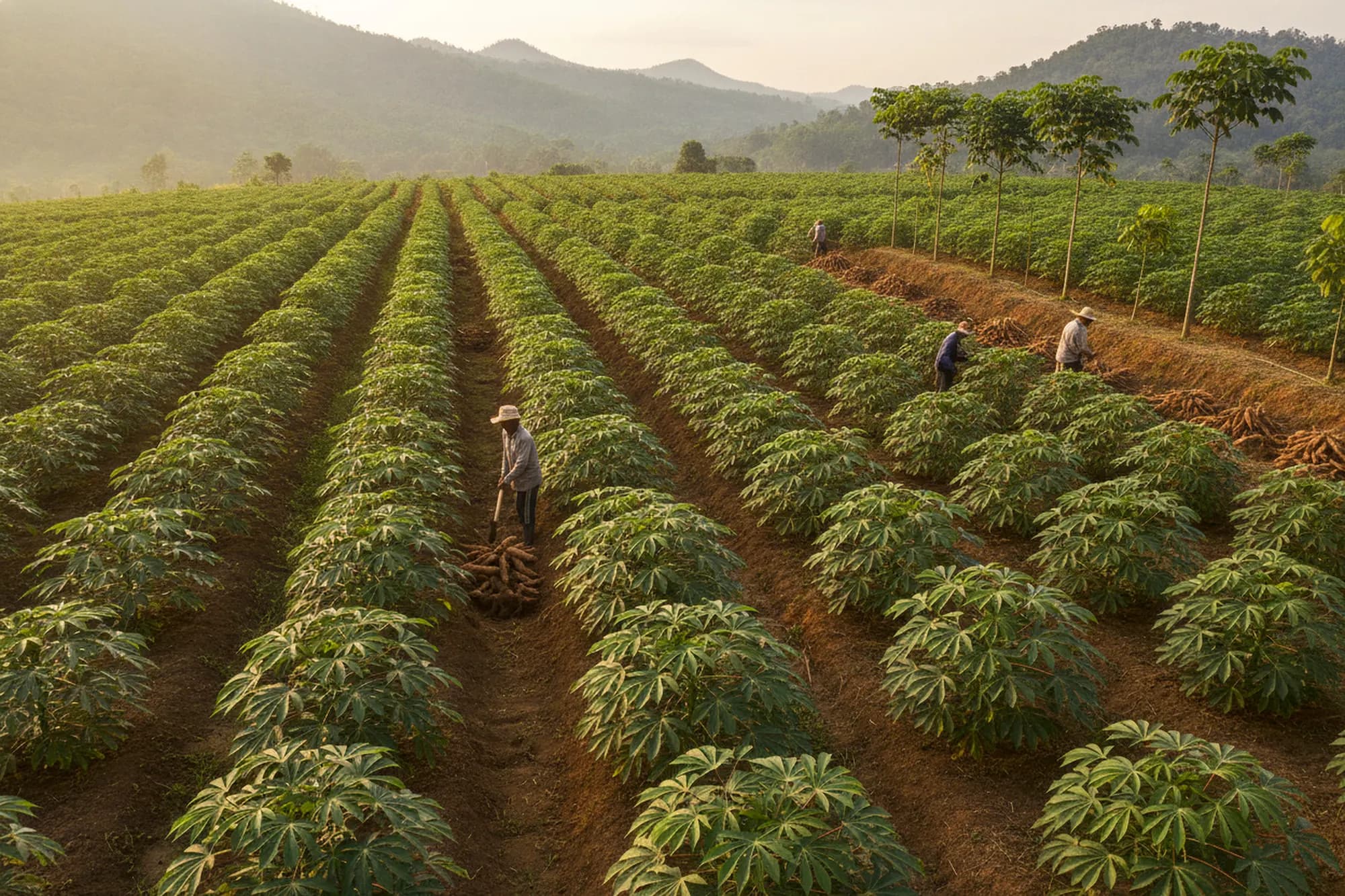
Food security is one of SBDI’s largest fields. It develops products from cassava, among them modified cassava flour (mocaf), and supplies production plants in Indonesia and Africa.
On behalf of Bank Indonesia, Prof. Jeroen Rijnenberg of SBDI is responsible for helping strong local food producers grow internationally, among them producers of herbs and spices, fruit and coffee. ESMI, landowners and cooperatives work with these producers, among other things to raise production.
After the clean-up
The landowner and the cooperative decide. SBDI helps set it up well.
How restored land is used is decided together with the landowners and cooperatives once tests show it is safe. SBDI brings the experience to set that up well, with proven technology and support from its partners.
- Forest
- Cassava and other crops
- Fruit
- Coffee
- Herbs and spices
- Fish ponds
- Eco-parks and eco-tourism
- Another use the village chooses
Policy and goals
How this policy relates to the 17 SDGs
This page sets out who is responsible and which principles ESMI works by. The SDG page shows, goal by goal, what the programme does, which UN target it serves and how progress is measured.
Together they link the clean-up to the goals: safe land for food (SDG 2), lasting work and income for the village (SDG 8), production without waste and toxins (SDG 12), life on land (SDG 15) and partnerships between villages, universities, companies and government (SDG 17).
Gotong royong
The pilot is under way. The next step is scale.
The pilot in Bolmong has started. ESMI is now raising large-scale funding to clean up Indonesia’s mine waste. Investors can start with one 10-tonner (USD 1.7 million).
ESMI also works as a hired partner. Mining companies and cooperatives can bring in ESMI to upgrade an existing plant with its microbes and methods, so it recovers more and can move away from mercury and cyanide.