Skip to content
ESMIEco Sustainable
Mining Initiative
Language
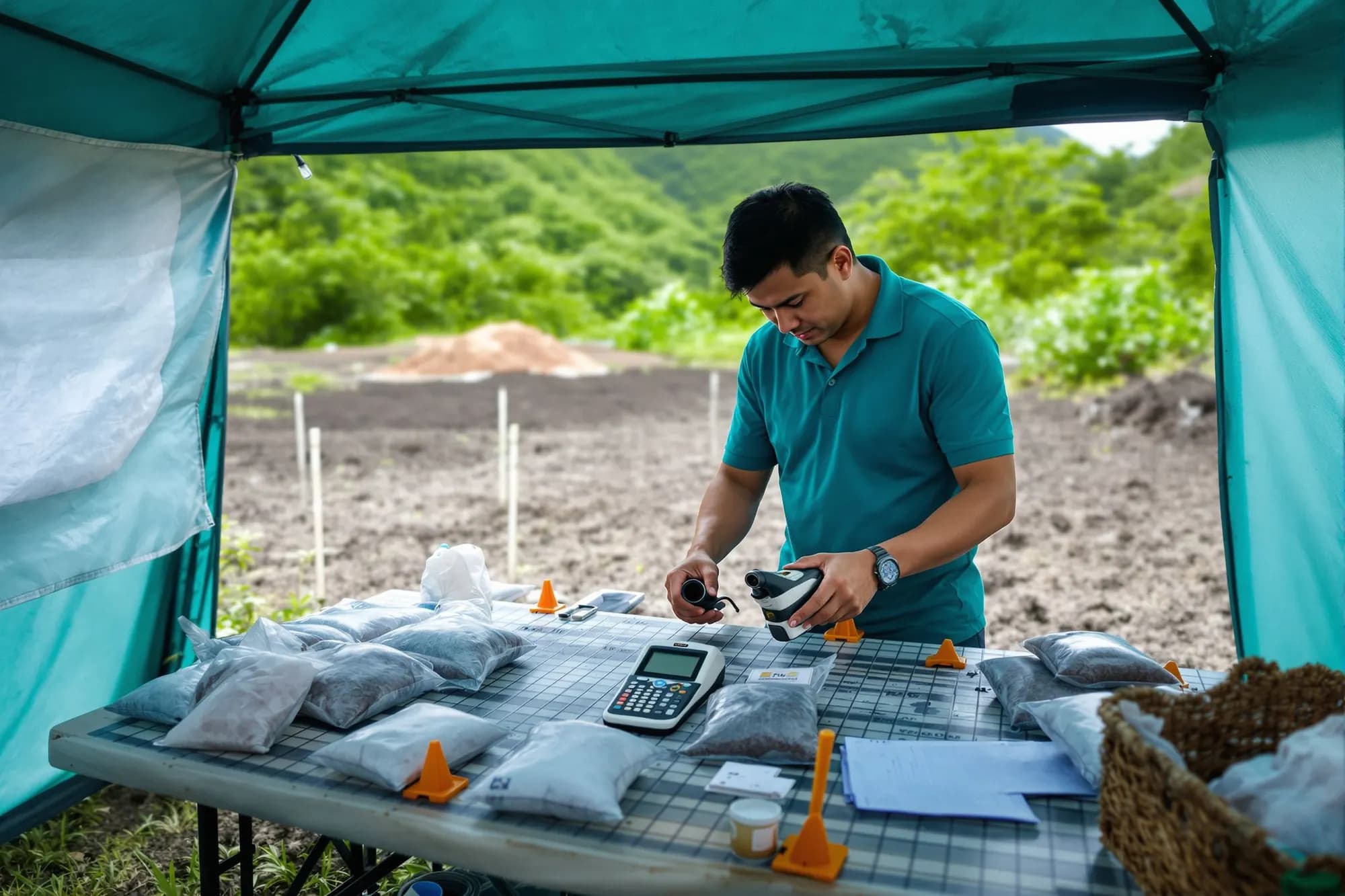
An ESMI field team taking samples of mine waste in a field tent

Research and evidence

What we know, how we know it, and what we still have to prove.

ESMI builds on published science and official data. Every claim on this site names its source. Every study below links to its source.

At a glance

What is proven, what is being tested, what we still have to show.

ESMI separates what science has already shown from what the pilot has to prove. Each point links to the study behind it.

  1. Proven

    Published studies and official sources

  2. Promising, being tested

    Shown in studies, now tested on site

  3. Still to prove

    Measured in the Bolmong pilot and the Unisma research series

    • How much mercury the 10-tonner removes per tonne of waste, with a mass balance that closes within ±15%.
    • Whether mercury in hair, urine, fish and rice near a site falls after the clean-up.
    • How much gold and other metal can be recovered from old waste.
    • Whether the bricks stay strong and safe after years of rain.
    • What the village uses the land for one year after it is handed back.

Key findings

Four numbers that define the problem.

Each comes straight from the source. None is an ESMI estimate.

  1. 37.7 %

    of global man-made mercury emissions to air come from small-scale gold mining

    Official sourceUN Environment Programme (2019) · Read the study: Global Mercury Assessment 2018

  2. 55 %

    of amalgam smelters (workers who burn gold bound with mercury) in North Sulawesi diagnosed with chronic mercury intoxication

    Published studyBose-O’Reilly S et al. (2010) · Read the study: Health assessment of artisanal gold miners in Indonesia

  3. 3.5 km

    distance over which mine tailings spread from the pipe outlet, up to nearby coral reefs

    Published studyEdinger E (2012) · Read the study: Gold mining and submarine tailings disposal: review and case study

  4. 15 / 18

    villagers with symptoms were classified as mercury-intoxicated

    Published studyBose-O’Reilly S et al. (2016) · Read the study: A preliminary study on health effects in villagers exposed to mercury in a small-scale artisanal gold mining area in Indonesia

Library

The evidence, study by study.

Filter by theme. Each entry gives a summary, the key finding, why it matters for ESMI and a link to the source.

13 studies shown

  1. Policy and law2019

    37.7 %of global man-made mercury emissions to air come from small-scale gold mining

    Global Mercury Assessment 2018

    UN Environment Programme · UN Environment Programme, Chemicals and Health Branch, Geneva · Official source

    The UN’s reference inventory of mercury released by people, by sector and region, for the year 2015.

    Key finding and citation
    Key finding
    Small-scale gold mining emitted about 838 tonnes of mercury to air in 2015: 37.7 % of roughly 2,220 tonnes. It is the largest single source.
    Why it matters for ESMI
    Small-scale gold mining is the largest single source of mercury to air. Mercury-free processing on legal sites cuts it at the root.

    Citation: UN Environment Programme (2019). Global Mercury Assessment 2018. UN Environment Programme, Chemicals and Health Branch, Geneva. Open the source

  2. Policy and law2019

    100 %mercury to be eliminated from small-scale gold mining, with 2025 as the target year

    Peraturan Presiden No. 21 Tahun 2019 tentang Rencana Aksi Nasional Pengurangan dan Penghapusan Merkuri (RAN-PPM)

    Republic of Indonesia · Lembaran Negara 2019 No. 73 · Official source

    Indonesia’s national action plan to reduce and eliminate mercury, with targets per sector.

    Key finding and citation
    Key finding
    Article 4 sets a target of 100 % elimination of mercury in small-scale gold mining (PESK) by 2025, against the level before the plan.
    Why it matters for ESMI
    The 2025 target was missed. ESMI’s programme is built to deliver it: legal sites, mercury-free processing and old waste cleaned up.

    Citation: Republic of Indonesia (2019). Peraturan Presiden No. 21 Tahun 2019 tentang Rencana Aksi Nasional Pengurangan dan Penghapusan Merkuri (RAN-PPM). Lembaran Negara 2019 No. 73. Open the source

  3. Policy and law2017

    Undang-Undang No. 11 Tahun 2017 tentang Pengesahan Minamata Convention on Mercury

    Republic of Indonesia · Lembaran Negara 2017 No. 209 · Official source

    The law by which Indonesia ratified the Minamata Convention on Mercury.

    Key finding and citation
    Key finding
    Indonesia became a party to the global treaty on mercury in 2017. The convention aims to protect health and the environment from man-made mercury.
    Why it matters for ESMI
    The treaty makes mercury-free gold mining an international commitment, not a choice. Funders look for that link.

    Citation: Republic of Indonesia (2017). Undang-Undang No. 11 Tahun 2017 tentang Pengesahan Minamata Convention on Mercury. Lembaran Negara 2017 No. 209. Open the source

  4. Mercury and health2010

    55 %of amalgam smelters (workers who burn gold bound with mercury) in North Sulawesi diagnosed with chronic mercury intoxication

    Health assessment of artisanal gold miners in Indonesia

    Bose-O’Reilly S et al. · Science of the Total Environment 408(4): 713–725 · Published study

    Doctors examined 281 people in two gold-mining areas: Talawaan in North Sulawesi and Galangan in Central Kalimantan.

    Key finding and citation
    Key finding
    Chronic mercury intoxication was diagnosed in 55 % of amalgam smelters (workers who burn gold bound with mercury) in Sulawesi and 62 % in Kalimantan. Neighbours were also affected.
    Why it matters for ESMI
    The harm is measured in human bodies, in the region where ESMI begins. It is why every site works mercury-free and stores mercury safely.

    Tested locally in Unisma theme: Mercury in fish, rice and people around gold waste (three regions)

    Citation: Bose-O’Reilly S, Drasch G, Beinhoff C, Rodrigues-Filho S, Roider G, Lettmeier B, Maydl A, Maydl S, Siebert U (2010). Health assessment of artisanal gold miners in Indonesia. Science of the Total Environment 408(4): 713–725. doi:10.1016/j.scitotenv.2009.10.070

  5. Mercury and health2016

    15 / 18villagers with symptoms were classified as mercury-intoxicated

    A preliminary study on health effects in villagers exposed to mercury in a small-scale artisanal gold mining area in Indonesia

    Bose-O’Reilly S et al. · Environmental Research 149: 274–281 · Published study

    A case report from Cisitu, a gold-mining village whose rice fields are irrigated with mercury-polluted water.

    Key finding and citation
    Key finding
    All 18 people examined had raised mercury in hair; 15 were classified as intoxicated. Polluted rice is a likely route.
    Why it matters for ESMI
    Mercury reaches the plate through rice and fish. ESMI and Unisma will measure fish, rice and people around the sites.

    Tested locally in Unisma theme: Mercury in fish, rice and people around gold waste (three regions)

    Citation: Bose-O’Reilly S, Schierl R, Nowak D, Siebert U, William JF, Owi FT, Ismawati Y (2016). A preliminary study on health effects in villagers exposed to mercury in a small-scale artisanal gold mining area in Indonesia. Environmental Research 149: 274–281. doi:10.1016/j.envres.2016.04.007

  6. Mercury and health2003

    Emissions and environmental implications of mercury from artisanal gold mining in North Sulawesi, Indonesia

    Limbong D et al. · Science of the Total Environment 302(1–3): 227–236 · Published study

    Water, river sediment and fish were sampled at 12 sites along the three main rivers of the Talawaan watershed.

    Key finding and citation
    Key finding
    Mercury in the rivers rose over time and spread downstream of the mining. The authors called for solutions before a health and ecological disaster.
    Why it matters for ESMI
    Waste on the slopes keeps feeding the rivers. Stopping new pollution is not enough; the heaps themselves must go.

    Tested locally in Unisma theme: Mercury in fish, rice and people around gold waste (three regions)

    Citation: Limbong D, Kumampung J, Rimper J, Arai T, Miyazaki N (2003). Emissions and environmental implications of mercury from artisanal gold mining in North Sulawesi, Indonesia. Science of the Total Environment 302(1–3): 227–236. doi:10.1016/S0048-9697(02)00397-2

  7. Mercury and health2012

    3.5 kmdistance over which mine tailings spread from the pipe outlet, up to nearby coral reefs

    Gold mining and submarine tailings disposal: review and case study

    Edinger E · Oceanography 25(2): 184–199 · Published study

    A review of tailings dumped at sea, with a case study of a former gold mine near Buyat Bay, North Sulawesi.

    Key finding and citation
    Key finding
    Tailings spread up to 3.5 km from the pipe and reached coral reefs. Methylmercury from the tailings entered the local food chain.
    Why it matters for ESMI
    Mine waste does not stay where it is dumped. ESMI processes waste on land, binds the mercury and stores it safely.

    Tested locally in Unisma theme: Mercury in fish, rice and people around gold waste (three regions)

    Citation: Edinger E (2012). Gold mining and submarine tailings disposal: review and case study. Oceanography 25(2): 184–199. doi:10.5670/oceanog.2012.54

  8. Microbes2012

    40–120 mgof mercury bound per gram of dry bacterial biomass

    Isolation and characterization of environmental bacteria capable of extracellular biosorption of mercury

    François F et al. · Applied and Environmental Microbiology 78(4): 1097–1106 · Published study

    Seven mercury-tolerant bacteria from polluted soil, effluent and river sediment were tested for how they hold mercury.

    Key finding and citation
    Key finding
    The bacteria bound mercury outside the cell, in their surface layer and slime. Inactive biomass held 40 to 120 mg of mercury per gram.
    Why it matters for ESMI
    This is the function ESMI microbes use: they immobilise mercury so it stays put. Field tests with Unisma check that it stays bound.

    Tested locally in Unisma theme: ESMI microbes in the field: making mercury solid and removing it, breaking down cyanide

    Citation: François F, Lombard C, Guigner JM, Soreau P, Brian-Jaisson F, Martino G, Vandervennet M, Garcia D, Molinier AL, Pignol D, Peduzzi J, Zirah S, Rebuffat S (2012). Isolation and characterization of environmental bacteria capable of extracellular biosorption of mercury. Applied and Environmental Microbiology 78(4): 1097–1106. doi:10.1128/AEM.06522-11

  9. Microbes2004

    Biological degradation of cyanide compounds

    Ebbs S · Current Opinion in Biotechnology 15(3): 231–236 · Published study

    A review of how microbes and plants break down cyanide left by industry, including gold mining.

    Key finding and citation
    Key finding
    Microbes break down cyanide by several routes, also metal–cyanide complexes. Physical and cost limits still slow its use.
    Why it matters for ESMI
    Cyanide can be broken down; mercury cannot, only bound. ESMI treats the two differently, and tests both on site.

    Tested locally in Unisma theme: ESMI microbes in the field: making mercury solid and removing it, breaking down cyanide

    Citation: Ebbs S (2004). Biological degradation of cyanide compounds. Current Opinion in Biotechnology 15(3): 231–236. doi:10.1016/j.copbio.2004.03.006

  10. Bricks from waste2013

    Durability and leaching behavior of mine tailings-based geopolymer bricks

    Ahmari S, Zhang L · Construction and Building Materials 44: 743–750 · Published study

    Bricks made from mine tailings were soaked in acidic and neutral water to test strength and leaching.

    Key finding and citation
    Key finding
    Heavy metals stayed locked in the brick. But strength fell substantially after long soaking, so the mix matters.
    Why it matters for ESMI
    Bricks only leave the site after leaching and strength tests. This paper shows why both tests are needed.

    Tested locally in Unisma theme: Bricks from cleaned mine waste: strength, leaching (TCLP), durability

    Citation: Ahmari S, Zhang L (2013). Durability and leaching behavior of mine tailings-based geopolymer bricks. Construction and Building Materials 44: 743–750. doi:10.1016/j.conbuildmat.2013.03.075

  11. Bricks from waste2026

    5–51 MPacompressive strength of tailings bricks across 15 studies

    Properties and durability of mine tailings geopolymer bricks: a systematic review

    Zúñiga-Torres B, Zúñiga-Suárez A · Buildings 16(21): 4377 · Published study

    A systematic review of 15 studies on unfired, cement-free bricks made from mine tailings.

    Key finding and citation
    Key finding
    Strength ranged from 5.48 to 50.53 MPa with curing at ambient temperature. Leaching tests confirmed that heavy metals were immobilised.
    Why it matters for ESMI
    Clean waste sand can become a building material instead of a new heap. ESMI’s bricks are tested to the same standards.

    Tested locally in Unisma theme: Bricks from cleaned mine waste: strength, leaching (TCLP), durability

    Citation: Zúñiga-Torres B, Zúñiga-Suárez A (2026). Properties and durability of mine tailings geopolymer bricks: a systematic review. Buildings 16(21): 4377. doi:10.3390/buildings16214377

  12. Cassava and MOCAF2023

    325 to 21 ppmnatural cyanide in bitter cassava, before and after fermentation into MOCAF

    Use of linamarase-producing lactic acid bacteria and yeast in the production of modified cassava flour from high cyanide cassava

    Dyah Hapsari R, Hartati NS · E3S Web of Conferences 454: 02006 · Published study

    Bitter cassava from Eastern Indonesia was fermented with selected starter cultures to make MOCAF (fermented cassava flour).

    Key finding and citation
    Key finding
    Seventeen hours of fermentation cut total cyanide from 325.1 ppm in fresh cassava to about 21 ppm in the flour.
    Why it matters for ESMI
    Controlled fermentation in a factory makes even bitter cassava a safe flour. That is how ESMI makes MOCAF: indoors, never on open racks.

    Citation: Dyah Hapsari R, Hartati NS (2023). Use of linamarase-producing lactic acid bacteria and yeast in the production of modified cassava flour from high cyanide cassava. E3S Web of Conferences 454: 02006. doi:10.1051/e3sconf/202345402006

  13. Cassava and MOCAF2024

    Production, biological activities and functional food of modified cassava flour (mocaf)

    Khasanah Y et al. · Canrea Journal: Food Technology, Nutritions, and Culinary Journal 7(2): 213–229 · Published study

    A review of how MOCAF is made, what it is used for and what is known about its health effects.

    Key finding and citation
    Key finding
    Cassava grows on marginal land at low cost. Fermented into MOCAF it can replace wheat flour in many foods and keeps far longer than fresh roots.
    Why it matters for ESMI
    Restored land needs a first crop that earns money. Cassava fields and a MOCAF factory give villages that income.

    Tested locally in Unisma theme: Restoration and biodiversity on cleaned cells; air around the sites

    Citation: Khasanah Y, Indrianingsih AW, Triwitono P, Murdiati A (2024). Production, biological activities and functional food of modified cassava flour (mocaf). Canrea Journal: Food Technology, Nutritions, and Culinary Journal 7(2): 213–229. doi:10.20956/canrea.v7i2.1280

How we know

Methods and sources.

A number is only as good as the way it was measured. This is how we work, and how we label what we do not know yet.

How sure is a number?

  • Official source

    Measured or official

    Our own lab results, or an official source such as a law, a UN assessment or national statistics.

  • Published study

    Published study

    A peer-reviewed article or review. We cite it with its DOI, so anyone can check it.

  • Field data

    Field data or comparable projects

    Regional data, prices, or results from a similar project elsewhere. Useful, but not yet ours.

  • Model estimate

    Model estimate

    A number from the ESMI model. It stays an estimate until the pilot and Unisma have measured it.

From screening to lab resultEach step answers a different question. No step replaces the next.
  1. Satellite and elevation data find and size the waste heaps. A blind sample is assessed automatically (AI); human checking with Unisma follows.
  2. Handheld XRF screens samples on site. It shows where to sample next; it is not the final number.
  3. A shaking table and lab chemistry measure the metals. Unisma labs and ESMI site labs run the analyses.
  4. One sample in ten is checked again in the accredited Unisma lab.
Mercury: bound, then proven boundMercury is an element. It cannot be broken down, only immobilised and stored.
  1. We measure total mercury and methylmercury before and after treatment.
  2. Leaching tests show whether bound mercury stays in place under rain and acidic water.
  3. The shaking table separates the bound mercury. It then goes to safe storage.
Bricks and landA cleaned cell is only handed back when the tests say so.
  1. Bricks from waste sand pass leaching (TCLP, the standard leaching test), strength and durability tests before use.
  2. Soil, water and crops on restored land are sampled again after planting.
  3. A social baseline records work and income before the work starts, and follows up.

Independent by design

  • Right to publish negative results

    Unisma may publish what does not hold up. ESMI only reviews for confidential data and IP.

  • Method fixed in advance

    Sample and analysis are set before results are known, and published with the article.

  • Two roles, two contracts

    The review has its own contract with a fixed fee, independent of the outcome.

  • Open about interests

    Every paper lists all of Unisma’s assignments for ESMI.

Research with Unisma

A ten-year research series, not a one-off study.

Unisma runs eight research themes alongside the work. Each publication either strengthens the figures in the plan or corrects them.

30–130publications planned in ten yearsUSD 1.85 mln · for research and publications, 2027–2036

  1. Starts 2027 to 2036

    • National mine-waste inventory (satellite, AI, blind review; Remote Sensing)
    • Mercury in fish, rice and people around gold waste (three regions)
    • Volume of waste heaps from elevation models and field measurement
  2. Starts 2028 to 2036

    • ESMI microbes in the field: making mercury solid and removing it, breaking down cyanide
    • POCO in process water: quality and reuse
    • Bricks from cleaned mine waste: strength, leaching (TCLP), durability
    • Work and income for former miners and villages (social baseline and follow-up)
  3. Starts 2029 to 2036

    • Restoration and biodiversity on cleaned cells; air around the sites

Business plan §§ 2.3, 3.4; model sheet Unisma (research and publications row, 3–13 articles a year); article on the mine-waste inventory (draft 0.2, intended for Remote Sensing).

Our own writing and data

What we publish ourselves.

Opinion and analysis by the ESMI team, and the open datasets behind the maps.

Article · Medium ·

Why Modified Cassava Flour (MOCAF) may be the answer to the global food crisis

An ESMI essay on why grain-based food systems are under strain, and why a fermented, climate-resilient cassava flour can help. Opinion, not a study.

Read on Medium

Datasets

  • Mine-waste data

    Indonesia in numbers: mine waste, mercury and the regions where the work starts.

    Open the data page
  • Open data

    Province and program figures as CSV files under CC BY 4.0, every number with its source.

    Open the downloads

Researchers and universities

Test our numbers with us.

Methods, data access, joint papers or a field visit with Unisma. Tell us what you study.

Contact us about research

All sources were checked online on 9 November 2026. Numbers are quoted only where the source states them.

Gotong royong

The pilot is under way. The next step is scale.

The pilot in Bolmong has started. ESMI is now raising large-scale funding to clean up Indonesia’s mine waste. Investors can start with one 10-tonner (USD 1.7 million).

ESMI also works as a hired partner. Mining companies and cooperatives can bring in ESMI to upgrade an existing plant with its microbes and methods, so it recovers more and can move away from mercury and cyanide.